NEWS & BLOG · October 29, 2026 · By Zhithera Studio
How many watts a waterless diffuser draws, what that costs at 2026 U.S. electricity prices, and where diffuser noise actually comes from. Every number below is sourced.
By Zhithera | October 29, 2026
Short answer: Micro-mesh atomizers run on roughly 1.5–2 W while misting. The Zhithera D1 lists approx. 1.5 W, lab-tested in continuous output mode [8]. A twin-fluid (air-pump) diffuser has to keep a pump running whenever it mists, and the two leading brands we checked don't publish a running wattage at all [4][5]. At the U.S. Energy Information Administration's projected 2026 residential average of 18.2¢ per kWh, every watt a diffuser draws for 8 hours a day costs about $0.53 a year [1]. And because a micro-mesh unit has no pump, there is no motor hum to damp in the first place.
Key takeaways
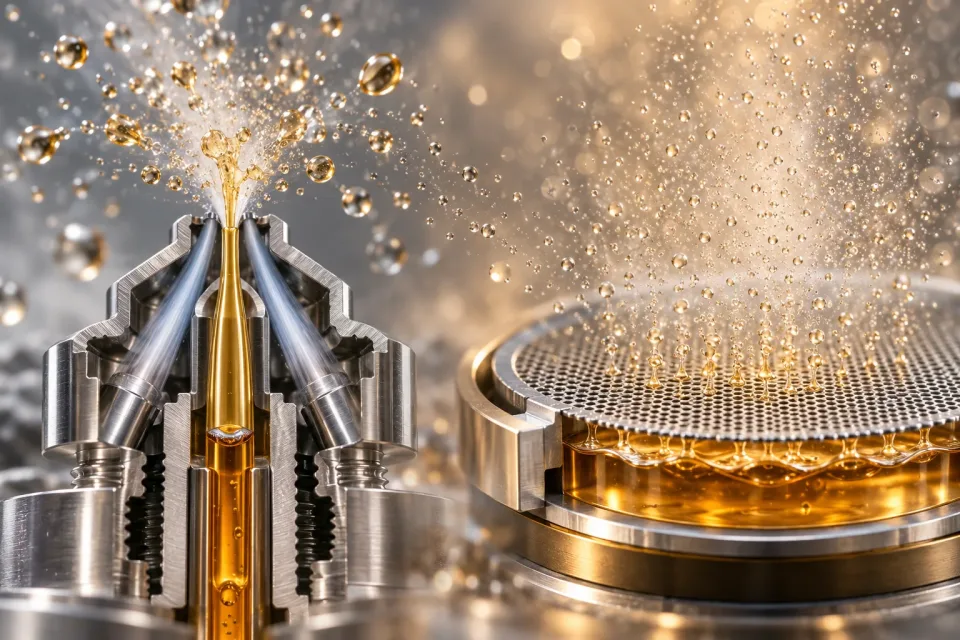
"Nebulizing" on a product page tells you a diffuser is waterless. It doesn't tell you how the mist is made. There are two common mechanisms:
For the wider engineering picture (oil compatibility, durability and manufacturing cost), see our technical guide to micro-mesh vs. twin-fluid atomization, or start with how waterless diffusers work. This article focuses on the two things you notice every day: electricity and sound.
Micro-mesh brands and component suppliers publish power figures. Air-pump diffuser brands mostly don't. Here is what each source states, as checked on October 29, 2026:
| Source | Technology | Published power | Notes |
|---|---|---|---|
| Zhithera D1 specifications [8] | Micro-mesh | Approx. 1.5 W while diffusing | Lab-tested in continuous (High) output mode. The charging base charges at approx. 12 W; that is charging power, not running power. |
| Microchip AN2265 reference design, 2017 [2] | Vibrating mesh | Below 2 W | Battery-powered reference design from a semiconductor manufacturer; drive signal approx. 117 kHz. |
| O-Two mesh nebulizer specification sheet [3] | Vibrating mesh | 1.5 W ±15% | A medical aerosol device, cited here only for the atomizer's power draw; vibrating frequency 117 kHz ±15%. |
| Organic Aromas Raindrop, official product page [4] | Air pump (Bernoulli principle) | Not published | Ships with a 12 V DC adapter; runs 2 minutes on, 1 minute off, and switches off after 120 minutes. |
| Aroma360 Michelangelo360, official product page [5] | Cold-air diffusion | Not published | No power specification listed. |
The three mesh sources land in the same place: about 1.5 W, and under 2 W. For an air-pump unit, the most reliable figure is usually printed on the power adapter: its output rating (volts × amps) is the ceiling for what the diffuser can draw.
In a twin-fluid design, electricity drives a motor, the motor drives a diaphragm or piston, and that pump pressurizes and moves air. Only then does the airflow break the oil into droplets, and much of the air's energy simply leaves the nozzle as moving air. A micro-mesh atomizer skips those steps: the electrical signal vibrates a plate that is already in contact with the oil [2][7].
Medical aerosol research uses the same two principles and shows the same pattern. A 2021 review in Lung India rates the portability of compressed-air (jet) nebulizers as "limited" and of vibrating-mesh nebulizers as "portable", running on battery or mains power [6].
Watts alone can mislead. A device that runs a long time because it releases very little scent isn't efficient. The fairer comparison is the energy used per milliliter of oil atomized. For the D1 in continuous mode, approx. 1.5 W ÷ approx. 4.3 mL per hour ≈ 0.35 Wh per mL [8]. When you compare diffusers, ask for both numbers in the same mode: power draw and mist output.
The formula is the same for any device:
kWh per year = watts × hours per day × 365 ÷ 1,000
Cost per year = kWh per year × your electricity price
For the price we use the EIA's Short-Term Energy Outlook, released October 6, 2026: the average U.S. residential price was 17.3¢ per kWh in 2025 and is projected at 18.2¢ for 2026 and 18.7¢ for 2027 [1]. Your own utility's rate may be higher or lower.
| Power draw | 4 hours a day | 8 hours a day | 24 hours a day |
|---|---|---|---|
| 1.5 W (micro-mesh, e.g. D1 in continuous mode) | 2.2 kWh · $0.40 | 4.4 kWh · $0.80 | 13.1 kWh · $2.39 |
| 5 W (example air-pump draw) | 7.3 kWh · $1.33 | 14.6 kWh · $2.66 | 43.8 kWh · $7.97 |
| 10 W (example air-pump draw) | 14.6 kWh · $2.66 | 29.2 kWh · $5.31 | 87.6 kWh · $15.94 |
Yearly figures at 18.2¢ per kWh. The 5 W and 10 W rows are example inputs, not measurements of any specific product, because air-pump brands rarely publish running wattage. Plug in the rating from your own adapter.
The table assumes rated power for the whole period, so treat it as a ceiling. Intermittent modes run the atomizer for only part of each cycle: the D1's Low setting mists for 10 seconds and rests for 5 minutes, Medium mists for 15 seconds and rests for 1 minute, and High runs continuously [8]. The air-pump model above runs 2 minutes on and 1 minute off [4].
For one diffuser on a bedside table, the gap is a few dollars a year. It grows with scale. A hotel running 40 units for 12 hours a day would use about 263 kWh a year at 1.5 W each (about $48 at the residential average), versus 1,752 kWh at 10 W each (about $319). Commercial tariffs differ, but the ratio holds. Our guide to scenting hotels, offices and vehicles covers multi-unit planning.
The bigger payoff of a low-power atomizer is that it can run without a wall cord. Battery capacity is fixed, so every watt the atomizer doesn't need goes into runtime or a smaller, lighter body.
Choosing between cordless models? Our rechargeable diffuser buying guide and cordless use cases cover room size, modes and runtime, and our cost vs. value breakdown adds oil use per hour to the picture.
A twin-fluid diffuser has three sound sources that a micro-mesh unit doesn't: the pump's motor, the diaphragm or piston pushing air in pulses, and air rushing through the nozzle. Pump vibration also travels into whatever the diffuser stands on. Even the maker of a well-regarded air-pump model describes "a gentle hum" and suggests that placing it on a soft surface makes it quieter still [4].
Good engineering can push that hum down a long way, and newer piezoelectric air pumps without rotating motors can be very quiet. But the pump is always there to be engineered around.
A micro-mesh diffuser has no pump. Its moving part is the mesh plate, driven at around 117 kHz in published designs [2][3], far above the upper limit of human hearing of about 20,000 Hz [9]. What you may notice is a soft puff of mist, the timer cycling, or the glow of the ambient light, not a motor.
The same split shows up in medical aerosol research: the Lung India review classes compressed-air (jet) nebulizers as "noisy" and vibrating-mesh nebulizers as "low/silent" [6].
The D1 and D1 mini have no air pump, and their mist is quiet. Quiet isn't the same as soundless, though, and no diffuser is literally silent. For setting one up on a nightstand, see our bedroom diffuser guide.
Reference points help. On a NIOSH chart, a whisper is about 30 dB and normal conversation about 60 dB [10].
A decibel figure only means something alongside its conditions: microphone distance, background noise, operating mode and how the device is mounted. Measurement standards such as ISO 11201 exist because those conditions change the number [11]. Published figures often leave them out. For example, one air-pump diffuser page lists "under 30 dB" [4], while a vibrating-mesh module's spec sheet lists 40 dB [3]. Neither states a distance, so the two can't be ranked against each other.
The practical test is simple. In a quiet room, listen from where you'll actually sit or lie down, first while the diffuser rests and then while it mists. A pump hum is easy to pick out against a quiet background.
Air-pump atomization is still a sound choice for large open spaces and for ducted HVAC scenting systems, where high, continuous output matters and the machine sits out of earshot in a plant room or ceiling void. For a bedside table, desk, office or car, low power and no pump are what matter day to day, and that's where micro-mesh fits. Browse our waterless diffusers to compare models.
| Factor | Micro-mesh | Twin-fluid (air pump) |
|---|---|---|
| How mist forms | Vibrating plate with microscopic holes | Pressurized air across a nozzle |
| Published running power | Approx. 1.5–2 W [2][3][8] | Rarely published; check the adapter rating |
| Moving parts | Mesh plate | Pump motor and diaphragm or piston |
| Main sound sources | Mist release, electronics | Pump hum, airflow, vibration into surfaces |
| Cordless operation | Common | Available on some models |
| Best fit | Bedside, desk, office, car | Large open rooms, HVAC scenting |
Micro-mesh diffusers typically draw about 1.5–2 W while misting; the Zhithera D1 lists approx. 1.5 W [8]. Air-pump models rarely publish running wattage, so check the output rating printed on the adapter.
At 18.2¢ per kWh [1], a 1.5 W diffuser running 8 hours a day uses about 4.4 kWh a year, roughly $0.80. Each additional watt on the same schedule adds about $0.53 a year.
No diffuser is literally silent, but a micro-mesh unit has no air pump, and its mesh vibrates far above the range of human hearing [2][9]. You may hear a soft puff of mist or the timer cycling.
If it's an air-pump (twin-fluid) model, the hum comes from the pump motor and the vibration it passes into the surface below. A soft mat or a different shelf can help, as one maker suggests [4].
Not by itself. Scent output depends on the mesh, the oil and the mode. Compare mist output in mL per hour, in the same mode, alongside power draw; the D1 lists both [8].
[1] U.S. Energy Information Administration — Short-Term Energy Outlook: Electricity, Coal and Renewables, released October 6, 2026. Residential electricity price: 17.3¢/kWh (2025), 18.2¢ (2026, projected), 18.7¢ (2027, projected). eia.gov (accessed October 29, 2026)
[2] Microchip Technology — Vibrating Mesh Nebulizer Reference Design, Application Note AN2265, 2017. Power rating below 2 W; piezoelectric drive signal approx. 117 kHz; battery-powered design. microchip.com (PDF)
[3] O-Two Medical Technologies — Mesh Nebulizer Specification Sheet. Power consumption 1.5 W ±15%; vibrating frequency 117 kHz ±15%; noise level 40 dB (measuring distance not stated). otwo.com (PDF) (accessed October 29, 2026)
[4] Organic Aromas — Raindrop Nebulizing Diffuser, official product page. Micro air pump using the Bernoulli principle; 12 V DC adapter; usage cycle 2 minutes on / 1 minute off with auto-off after 120 minutes; noise listed as "under 30 dB" (distance not stated); soft-surface placement tip. organicaromas.com (accessed October 29, 2026)
[5] Aroma360 — Michelangelo360, official product page. Cold-air diffusion; no power specification listed. aroma360.com (accessed October 29, 2026)
[6] Talwar D, et al. — "The emerging role of nebulization for maintenance treatment of chronic obstructive pulmonary disease at home." Lung India. 2021;38(2):168–173. Table 3 compares jet and mesh nebulizers by power source, portability and sound. PubMed Central
[7] Lechler — Pneumatic Atomization. How compressed air atomizes liquid in internal- and external-mixing nozzles. lechler.com
[8] Zhithera — D1 Waterless Nebulizing Diffuser specifications. Diffusing power approx. 1.5 W (lab-tested in continuous output mode); charging base approx. 12 W; mist output approx. 0.14 / 0.87 / 4.3 mL per hour (Low / Medium / High); Low 10 s mist / 5 min rest, Medium 15 s / 1 min, High continuous; 3,500 mAh rechargeable power base.
[9] U.S. National Park Service — Understanding Sound. "Humans with normal hearing can hear sounds between 20 Hz and 20,000 Hz." nps.gov (accessed October 29, 2026)
[10] NIOSH and CPWR — Noise Levels by Decibels (infographic), October 20, 2015. Whisper 30 dB; normal conversation 60 dB. CDC Stacks
[11] International Organization for Standardization — ISO 11201:2010, Acoustics — Noise emitted by machinery and equipment — Determination of emission sound pressure levels at a work station and at other specified positions. iso.org
[12] Zhithera — D1 mini specifications. Built-in 420 mAh battery; motion-sensing car mode.
This article compiles manufacturers' published specifications, a peer-reviewed review and public reference data. It is not an independent laboratory comparison, and the 5 W and 10 W figures in the cost table are example inputs rather than measurements of any product.
Some sources describe medical nebulizers. They are cited only for the power and sound characteristics of the two atomization methods, and Zhithera diffusers and oils are intended for non-medical home fragrance use.
Electricity prices vary by state and utility, and real power draw depends on the device, mode and settings.
Zhithera – A Professional Aromatherapy Delivery System Zhithera designs waterless, heat-free diffusers that atomize pure botanical essential oils and designer fragrance oils into a micron-fine mist using Advanced Micro-Mesh Atomization. Built for consistent, controllable aromatic states — focus, relaxation, recovery and restful ambiance — our range serves homes, offices, cars, spas, hotels and retail spaces worldwide. Every batch is traceable and supported by recognized third-party testing, with dependable wholesale and distribution support for partners around the globe.
Aromatherapy & Essential Oil Notice
Zhithera essential oils and fragrance oils are non-medical aromatic products intended for diffusion only. They are not intended to diagnose, treat, cure or prevent any disease or condition, and are not medical devices. Do not apply oils to skin or ingest them, and keep oils and devices out of reach of children and pets. Ensure good ventilation, and if you are pregnant, nursing or have a medical condition, please consult a qualified professional before use. Scent is experienced differently by everyone; discontinue use if any irritation occurs. We make no therapeutic, disinfecting or insect-repellent claims for any Zhithera product.